Trading 212 Interest on Cash: Where It Sits and FSCS Cover
Trading 212 interest on cash can sit in a bank or a money market fund, and the FSCS limit is £85,000 or £120,000 depending on which. How each one works.
Trading 212 interest on cash is paid daily on money you have not yet invested, but where that money sits changes how it is protected. In the Invest account and the Stocks and Shares ISA, part of your cash can be placed in a qualifying money market fund (QMMF) rather than a bank. In the Cash ISA and the SIPP it stays in bank deposits. That one difference decides whether the £120,000 deposit guarantee is relevant to you at all.
This page goes through each Trading 212 account in turn: where the cash goes, how the rate is set, what happens if Trading 212 or one of its banks fails, and how the interest is taxed. Everything here is taken from Trading 212’s own help centre, checked in October 2026. If you want the wider view of the app first, read our Trading 212 review.
The short answer by account
| Account | Where uninvested cash is held | How the rate is set | Taxed? |
|---|---|---|---|
| Invest (general account) | Bank deposits and/or QMMFs, once you opt in | Published rate for new clients; your own rate shows in the app | Yes, as interest |
| Stocks and Shares ISA | Bank deposits and/or QMMFs, once you opt in | Published rate for new clients; your own rate shows in the app | No, inside the ISA |
| Cash ISA | Bank deposits only | Bank of England base rate minus 0.15% | No, inside the ISA |
| SIPP | Bank deposits and/or term deposits only | Fixed published rate, 3.00% AER from 26 October 2026 | No, inside the pension |
The interest is optional on the Invest account and the Stocks and Shares ISA. You switch it on from the “Interest on cash” dashboard in the app menu, and for accounts where cash may go into QMMFs you also have to consent to that before it starts. You can switch it off again at any time.
How the daily payment works
Trading 212 calculates interest at 22:00 GMT on whatever free cash is in the account at that moment, and pays it between 01:00 and 02:00 GMT. There is no minimum or maximum balance. Rates are quoted as AER, and the daily amount is your balance multiplied by the AER converted to a daily rate over 365.25 days.
Two practical points follow from the 22:00 snapshot. Cash you deposit and invest the same afternoon earns nothing for that day, and cash from a sale that has not settled by the evening may not count yet. If you are parking a lump sum before investing it in stages, the interest is a genuine bonus; if you are trading in and out every day, it barely registers.
The Cash ISA is slightly different: interest accrues daily but is paid once a month, on the third calendar day.
What a qualifying money market fund actually is
A QMMF is a fund that holds very short-term, low-risk assets such as government bonds and aims to keep a stable value. The “qualifying” part means it meets the regulatory tests that let firms treat it as a cash equivalent. Pension funds, insurers and banks use them to hold large cash balances.
The important word is fund. Money in a QMMF is an investment, not a bank deposit. Trading 212 lists four risks on its own help page:
- Credit risk. If a QMMF your cash is in became insolvent, “you may lose some of your cash.”
- Management risk. The fund manager’s choices affect returns.
- Interest rate risk. Rising central bank rates can lower the value of the bonds the fund holds.
- Liquidity risk. In extreme markets, a rush of withdrawals could cause delays. Trading 212 says it keeps enough client money in liquid cash to process withdrawals immediately.
For most people these risks are small. QMMFs are among the most conservative funds there are. But it is wrong to describe the money as “in the bank”, and that is where the protection question comes in.
Is the cash FSCS protected?
There are two separate FSCS limits, and which one applies depends on who fails.
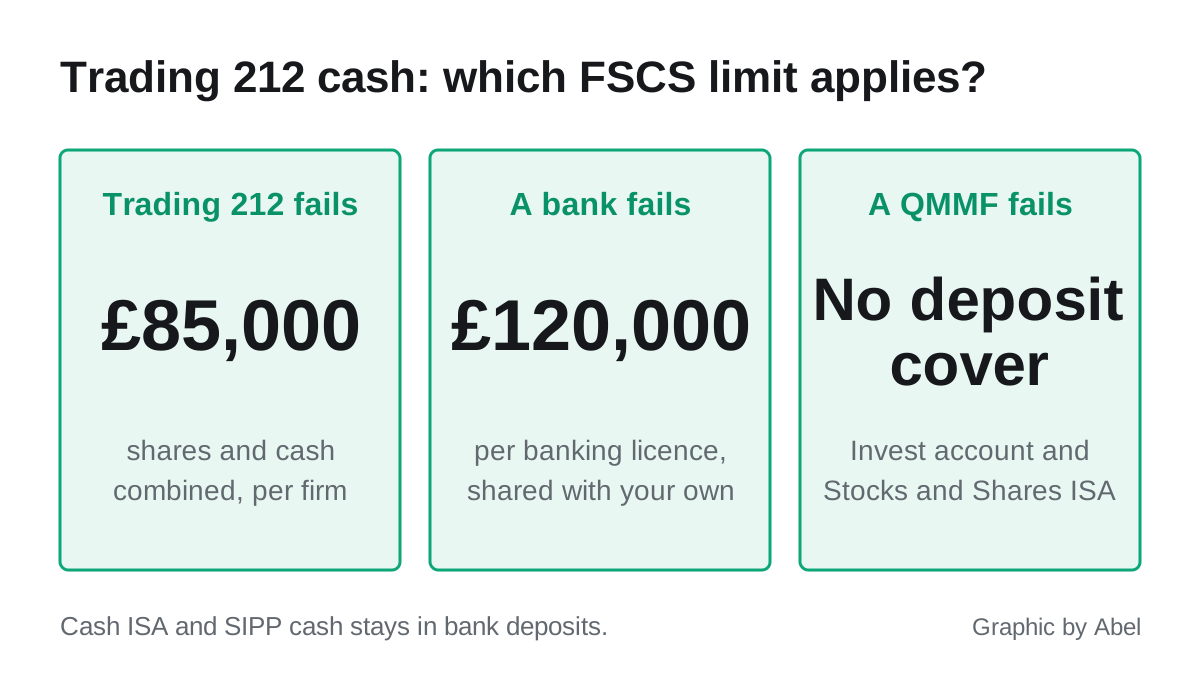
If Trading 212 itself fails: £85,000. Trading 212 UK Ltd is an FCA-regulated investment firm and a member of the Financial Services Compensation Scheme. If it collapsed and client money or assets were missing, FSCS investment protection covers up to £85,000 per eligible person, per firm. That is one combined limit for your shares and cash together, not £85,000 each. In practice, the first line of defence is segregation: Trading 212 keeps client money in separate client money bank accounts at major banks (it names J.P. Morgan and Barclays) and holds shares with custodians (The Bank of New York Mellon and Interactive Brokers), apart from its own money, under the FCA’s client asset rules.
If one of the banks fails: £120,000. Cash held as a bank deposit is covered by FSCS deposit protection up to £120,000 per eligible person, per banking licence. That limit rose from £85,000 on 1 December 2025. The catch Trading 212 points out itself: the £120,000 is shared with any money you hold directly at the same bank. If you bank with Barclays and hold £100,000 there, only £20,000 of further cover is left for anything Trading 212 places with Barclays on your behalf.
If a QMMF fails: no deposit protection. Because a QMMF is a fund rather than a bank account, the deposit guarantee does not apply to the portion of your cash placed in one. This is the trade you make by switching interest on in the Invest account or Stocks and Shares ISA.
The Cash ISA and the SIPP avoid the QMMF question entirely, because Trading 212 holds that cash only in bank deposits. For a big balance you want treated strictly as savings, the Cash ISA is the cleaner home. The FSCS explains both kinds of cover on its page about how investments are protected.
How the Cash ISA rate is set
Trading 212’s Cash ISA is a tracker. The rate sits 0.15 percentage points below the Bank of England base rate, which Trading 212 calls the “T212 Tracking Rate”. The Bank of England has held Bank Rate at 3.75% since 18 December 2025, which puts the standard Cash ISA rate at 3.60% AER. When the Bank changes its rate, the Cash ISA moves straight away. If Trading 212 wants to widen its 0.15% margin, it has to give you 14 days’ written notice.
New customers can sometimes get a fixed promotional top-up on the standard rate for a set period, if they open the Cash ISA through a promotional link, have never held a Trading 212 account, and fund it within 10 days. The bonus is added on top of the tracker and ends on a fixed date, so the base rate can still move underneath it. ISA transfers only earn the bonus on money your old provider reports as a current tax year contribution. Our page on what happens when a bonus rate ends covers the drop-off.
The Cash ISA is flexible: you can take money out and put it back in the same tax year without using more of your £20,000 allowance. That allowance is changing for cash from April 2027; see the Cash ISA limit cut.
The SIPP rate falls on 26 October 2026
Trading 212 has told SIPP customers that the interest on uninvested cash will drop from 3.80% to 3.00% AER from 26 October 2026. Its explanation is unusually open: the SIPP has no account, custody or trading fees, so Trading 212 funds it by keeping the gap between what the banks pay it and what it passes on, plus its 0.15% FX fee. SIPP cash stays in bank deposits with FSCS cover up to £120,000 per bank, and you do not need to do anything.
If you hold a large cash balance in the SIPP while you wait to invest, compare that 3.00% with what the same money would earn in a money market fund bought inside the SIPP as an investment.
Is Trading 212 cash interest taxed?
Inside either ISA or the SIPP, no. Outside them, yes. For the Invest account Trading 212 says the payments “should be treated as interest income for UK tax purposes”, whether the money went to a bank or to a QMMF. That means it counts towards your Personal Savings Allowance (£1,000 for basic-rate taxpayers, £500 for higher-rate, nothing for additional-rate) along with interest from every other account you have. Trading 212 does not deduct tax, so anything over your allowance is yours to report. Our page on how savings interest is taxed has the full rules, including the £5,000 starting rate for savings.
Should you switch it on?
For a Stocks and Shares ISA where cash sits between purchases, there is little reason not to. The sums are usually modest and the QMMF risk is small. For a large balance you think of as savings, rather than money waiting to be invested, the Cash ISA keeps it in bank deposits under the £120,000 guarantee, and gives you a rate you can check against the Bank of England’s. For an emergency fund, see where to keep an emergency fund. And if you want the wider picture of what protects your money on any platform, read is my money safe in an investing app.
Frequently asked questions
Does Trading 212 pay interest on cash? Yes. Uninvested cash in the Invest account, Stocks and Shares ISA, Cash ISA, SIPP and CFD account can all earn interest, calculated daily on the balance at 22:00 GMT. There is no minimum balance.
Is Trading 212 interest on cash safe? Cash held as a bank deposit is covered by the FSCS up to £120,000 per bank. Cash placed in a qualifying money market fund is an investment and has no deposit protection, although QMMFs are very low-risk funds. If Trading 212 itself failed, FSCS investment protection covers up to £85,000 of shares and cash combined.
What is the Trading 212 Cash ISA interest rate? It tracks the Bank of England base rate minus 0.15%. With Bank Rate at 3.75%, that is 3.60% AER before any new-customer bonus. Your exact rate is shown on the Cash ISA home screen.
Does the Cash ISA use money market funds? No. Trading 212 holds Cash ISA money in deposits with third-party banks, and SIPP cash in bank deposits and term deposits.
Do I pay tax on Trading 212 interest? Not inside an ISA or the SIPP. In the Invest account it counts as interest income, so it uses up your Personal Savings Allowance and any excess is taxable.
Can I turn interest on cash off? Yes. Open “Interest on cash” from the app menu and disable it; your cash then stays with Trading 212’s banks. You can turn it back on whenever you like.
Sources
- Trading 212 help centre: What is interest on cash?, What are the risks of QMMFs?, Funds and assets protection, Cash ISA Interest Rate (Tracker), Upcoming change to the interest rate on cash for SIPP accounts, Tax on Interest Income for UK Tax Residents (all read October 2026)
- Bank of England: Bank Rate history
- FSCS: investment protection