Money Market Funds in UK Apps: Who Pays 4% and What It Costs
Money market funds in UK apps explained: Lightyear Vaults pay 4.00% after 0.20% fees, ETFs cost 0.05% to 0.10%, and none are FSCS deposits. Checked 10 Nov.
A money market fund in a UK app is the closest thing an investing platform has to a savings account: your cash buys units in a fund that lends very short term to governments and large banks, and you get the interest those loans earn, minus a fee. Lightyear Vaults currently pays 4.00% AER on sterling after 0.20% of fees, InvestEngine sells sterling cash ETFs with yearly charges of 0.05% to 0.10%, and Trading 212 places some of your uninvested cash in qualifying money market funds behind the scenes.
The catch is the same in every app. These are investments, not bank deposits, so the £120,000 FSCS deposit guarantee does not apply to them. The rate changes daily and follows the Bank of England, which raised Bank Rate from 3.75% to 4% on 5 November 2026.
We checked the figures below on Lightyear’s help centre, Trading 212’s help centre and InvestEngine’s fund pages on 10 November 2026.
How a money market fund pays you
The fund holds hundreds of short loans: Treasury bills, deposits at large banks and commercial paper that mostly matures within weeks. Lightyear says the BlackRock sterling fund behind its Vaults has an average maturity of 45 days, more than 300 holdings, and between 20% and 50% of its assets maturing every day. Because the loans are so short, the fund’s income moves almost in step with Bank Rate.
What reaches you is the fund’s yield minus two layers of cost:
- The fund manager’s charge, taken inside the fund.
- The app’s charge, either a separate fee (Lightyear) or a margin built into the rate it pays you (Trading 212).
Lightyear shows its own sum on its money market page: a 4.13% yield, minus 0.20% of fees, gives 3.93%, which compounds to 4.00% AER because interest is reinvested monthly. Leave £10,000 there for a year and you would earn about £400 if the rate never moved. It will move.
The three ways UK apps offer them
The phrase “money market fund” covers three quite different set-ups in UK apps, and the differences matter more than the headline rate.
| Lightyear Vaults | Trading 212 interest on cash | InvestEngine cash ETFs | |
|---|---|---|---|
| What you hold | Units in BlackRock money market funds | Cash, part of which Trading 212 places in qualifying money market funds | Exchange-traded funds you buy and sell yourself |
| Who sets your rate | The fund’s daily yield, minus fees | Trading 212, at its discretion | The fund’s return, minus its TER |
| Yearly cost | 0.20% total on GBP (fund plus Lightyear) | Built into the rate | 0.05% to 0.10% TER, no platform fee |
| How interest arrives | Paid monthly, reinvested by default | Paid daily (Cash ISA monthly) | Inside the ETF price (accumulating) or paid out (distributing) |
| Accounts | General account, Stocks and Shares ISA | Invest, Stocks and Shares ISA, Cash ISA, SIPP | ISA, SIPP, general account, business account |
| FSCS deposit cover | No, not while in the fund | Only on the part held at banks | No |
Lightyear Vaults: a real money market fund, wrapped
Lightyear’s Vaults are the most direct version. When you add money, Lightyear places a buy order for the BlackRock fund in your name, and when you withdraw, it sells. Most moves finish within minutes, though Lightyear says some take up to two business days, usually larger amounts or money from a share sale that has not settled.
Its help centre lists the rates and total fees for each currency: sterling 4.00% AER with 0.20% fees, US dollars 3.94% with 0.25%, and euros 2.47% with 0.20%. The fee is already taken off the rate shown. Interest is paid on the first business day of each month and reinvested unless you switch that off.
Two practical limits. Money in a Vault cannot buy shares directly, so you withdraw to cash first. And Vault units cannot be transferred to another provider: if you move your ISA, the Vault has to be sold first. Our Lightyear review covers the rest of the app.
Trading 212: you hold cash, Trading 212 holds the funds
Trading 212 does not sell you fund units. You switch on interest on cash, agree that your cash can be held in qualifying money market funds (QMMFs), and Trading 212 spreads client money between banks and those funds. It pays you a rate it publishes, which it says is based on what the banks and funds pay it and can change at any time.
Interest is paid every day, worked out at 22:00 GMT on your free cash. Cash ISA interest builds daily but is paid on the 3rd of each month. SIPP cash is held only in bank deposits, never in QMMFs, which is why the SIPP has its own lower rate. You can see the split between “Cash in banks” and “Cash in QMMFs” in the app and on your monthly statement.
The protection follows the split. Cash at a partner bank has FSCS deposit cover up to £120,000 per bank licence; cash in a QMMF does not, and Trading 212’s own risk page says that if a QMMF failed “you may lose some of your cash”. We go through the details in Trading 212 cash interest explained.
InvestEngine: cash ETFs you trade like shares
InvestEngine has no cash interest at all. Uninvested cash earns nothing, so to get a money market return you buy an ETF from its “Money Market & Overnight Rate” range. On 10 November 2026 the sterling funds were:
- UBS GBP Overnight Rate SF (GBPO): TER 0.05%, accumulating.
- HSBC Sterling Liquidity Fund (HGBP): TER 0.10%, accumulating. This is an ETF share class of HSBC’s existing sterling money market fund, listed in London in November 2025.
- Amundi Smart Overnight Return (CSH2): TER 0.10%, accumulating.
- Invesco GBP Overnight Return Swap (GONS): TER 0.10%, accumulating.
- Xtrackers II GBP Overnight Rate Swap (XSTR): TER 0.10%, distributing, paying out twice a year.
Here is the point most comparison pages skip: only HGBP in that list is a money market fund in the regulatory sense. The other four use swaps to track SONIA, the overnight rate banks pay each other, which InvestEngine calls “overnight rate ETFs”. They do the same job and the returns are very close, but you are relying on a swap counterparty as well as the fund’s collateral. InvestEngine charges no platform fee on any of them. Our InvestEngine review explains the rest of its costs.
Buying and selling happens on the stock exchange during market hours, with a small spread, and cash from a sale typically settles in one to two business days. That makes an ETF slightly slower to get out of than a Lightyear Vault.
Fees: small numbers that add up on a big balance
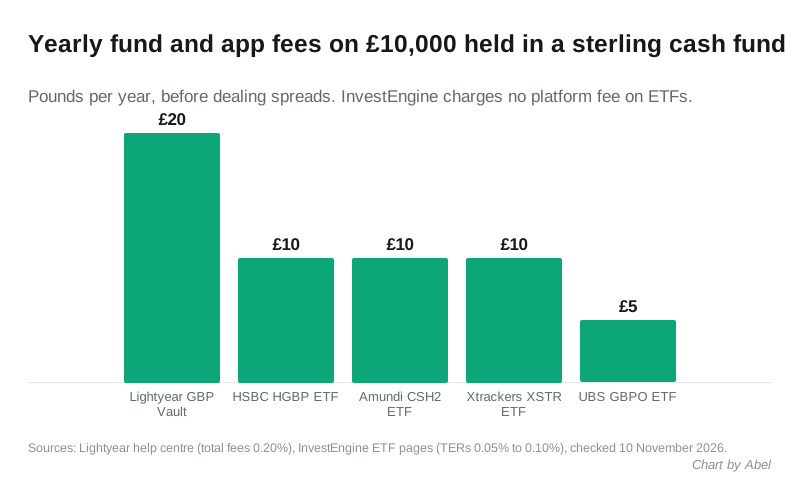
On £10,000 held for a year, the yearly charges come to about £20 in a Lightyear sterling Vault, £10 in HGBP, CSH2, GONS or XSTR, and £5 in GBPO. ETF holders also pay a dealing spread each time they buy and sell, so the gap narrows if you move money in and out often.
Trading 212 shows no separate fee, but that does not make it free: its margin is the difference between what the banks and funds pay it and the rate it passes on. Compare the rate you actually receive in each app, not the fee line.
Is a money market fund safe?
Safer than shares, not as safe as a bank account. The funds Lightyear uses are AAA rated and rated 1 on the 1-to-7 risk scale, and regulations limit any single holding to 5% of the fund. Even so, the value can in principle fall, and none of these products carries FSCS deposit cover.
What the FSCS can cover is the platform itself. If Lightyear, Trading 212 or InvestEngine failed and assets were missing, you could claim up to £85,000 under the FSCS investment limit. That is a different protection from the £120,000 deposit guarantee, and it does not cover a fall in the fund’s value. The FSCS investments page sets out what counts. We explain how the two limits fit together in is my money safe in an investing app.
Tax on money market fund returns
Inside a Stocks and Shares ISA or a SIPP there is no tax to pay. Outside a tax wrapper, income from money market and overnight rate funds is generally taxed as savings interest, so it counts against your Personal Savings Allowance: £1,000 for basic rate taxpayers, £500 for higher rate and nothing for additional rate, as set out on GOV.UK.
Accumulating ETFs are the trap here. You receive no payout, but the fund still reports income each year and that income is taxable outside an ISA. Lightyear also does not deduct any tax from Vault interest, so reporting it is up to you.
When a money market fund makes sense
- Cash waiting to be invested inside an ISA or SIPP. This is the best use: the money keeps earning close to Bank Rate and stays inside the wrapper.
- A large balance above the FSCS limits at one bank, where you accept a small investment risk in exchange for spreading it across hundreds of borrowers.
- Not your emergency fund, unless you are comfortable that it is an investment. For money you might need next week, an easy-access savings account with FSCS cover is simpler. See where to keep an emergency fund.
If you are choosing an app to start with, our best investment apps for beginners compares the main options.
Frequently asked questions
What is the best money market fund app in the UK? It depends on how you want to hold it. Lightyear Vaults are the simplest, with a single daily rate after fees and moves that usually complete in minutes. InvestEngine is cheapest on fees, with sterling ETFs from 0.05% and no platform fee. Trading 212 needs the least effort, because interest is paid on your cash automatically.
Are money market funds protected by the FSCS? Not as deposits. The £120,000 FSCS deposit guarantee only covers cash held at a bank. If the app holding your fund failed and your units were missing, the FSCS investment limit of up to £85,000 could apply, but it never covers a fall in the fund’s value.
Can you lose money in a money market fund? Yes, although it is rare. The funds hold very short, highly rated loans, so their value barely moves, but Trading 212’s own risk page says that if a QMMF failed you may lose some of your cash. They are investments, which is why every app shows a capital at risk warning.
How quickly can I get my money out? Lightyear says most Vault withdrawals complete within minutes, with some taking up to two business days, and the money returns to your Lightyear cash balance first. An InvestEngine ETF sells during market hours and typically settles in one to two business days. Trading 212 cash is withdrawable at any time.
Do money market fund rates change? Yes, daily. They follow the Bank of England’s Bank Rate closely, so the rise to 4% on 5 November 2026 should lift returns over the following weeks, and any cut would lower them.
Can I hold a money market fund in an ISA? Yes. Lightyear offers Vaults in its Stocks and Shares ISA, InvestEngine’s cash ETFs can go in its ISA or SIPP, and Trading 212 pays interest on uninvested cash in its Stocks and Shares ISA.